I am reviewing some chapters for non-majors biology textbooks.
It is making me grumpy.
One of the books appears to have been written directly in response to needs that I and other Professors perceive and complain about to book companies. Biology, medicine, health, and ecology are becoming increasingly important to understand as an informed citizen. College Biology classes for non-majors should provide scientific literacy, an understanding of what science is, and useful, practical information.
Here and there, through my extensive education in the biological sciences, I have unearthed some tidbit of immediate practical import. I have understood for years the problems with partially hydrogenated vegetable oils, over-use and incorrect use of antibiotics, the fact that cervical cancer is primarily a sexually transmitted disease, that eating a lot of meat is hard on the world’s resources, that goose-bumps are an evolutionary remnant of the reflex that allows other mammals to fluff their coats in response to cold or fear.
These and many other useful and/or interesting bits of knowledge do not really require a Ph.D. to comprehend. In turn they can be instructive on the basic processes of biology. Why not write a non-majors biology text packed with these useful tidbits used as examples of categories of biological processes?
So, this author has aimed to do just that.
Hurrah!
But, the text is often convoluted and impenetrable. To make matters worse, throughout the book are question for students to answer to monitor their progress. A great idea, yes? But the questions are fill in the blank, which can be ok, but are too often bad. If the question is a repetition of a sentence in the text, with a key word or two missing then the student simply needs to find the sentence and dutifully copy the word. This does not require any understanding of the concept or process discussed. It does not require understanding the definition of the word. It does not even require an understanding of the English language. It only requires pattern recognition. Furthermore it encourages plagiarism, copying being correct.
I have students in my classes at my university who have had many such “tests” and they are great at pattern recognition. The ones with high grades are often great memorizers in general. They often understand little. They resent me for using different wording on my test questions than I used on my slides in lecture, or that they read in the book. They think I ask too much in requiring them to understand something.
Who would write such questions? What do they think they are teaching? Grrrr.
Sunday, November 27, 2005

Friday, November 25, 2005
Requiem
Champion Ti Shebi’s Orange Julius of Synergy
March 2000 – November 2005
I first saw Julius at a showhall. He was a bright-eyed bright orange little thing of about 5 months old, he had no stripes at all and a bright white undercoat. A true red smoke. The color so rare I had never seen it before. I wanted him. After some negotiating, his breeder, a friend, entrusted him with me.
He was a sweet and silly boy. He started out with a newly neutered older ex-stud, Robinhood, as a companion in Diana’s bedroom. The ten year old and the kitten were soon fast friends, and competed in goofyness, purring, wanting belly-rubs and playing with anything available. One of Julius’s favorite toys was a scrap of paper.
His personality never changed from kittenhood through being a stud to being a neuter and around the house pet.
He had the attention span of a gnat and loved toys. This made him endlessly amusing. He would trot across the room (he rarely walked) and spot a toy.
“A toy!” his expression indicated. “The coolest toy!” He’d grab it, toss it high in the air, bounce high himself, thunk down with it and kick it, leap up and toss again. Then at some point he’d toss it over his shoulder and lose track of it. He’d stop, looking both excited and confused.
“What? What what? What was happening? .... Oh well” and trot on. Then coming back around he’d spot it.
“A toy!” “The coolest toy!” and up in the air it would fly.
Julius also loved strangers. He would greet visitors at the door and often fly unexpected onto their shoulders. He purred hard,kneeded his long monkey toes on the human's shoulders and chest, bonked his head against them, enjoying contact, then wiggle-squirm to get down and run around, only to come back. The littlest thing would have him purring and quivering in excitement.
He fathered one litter of kittens and was then neutered. He helped raise his babies, sleeping with them, cleaning them, playing with them, and looking confused when they sucked on his belly.
He was never a wonderfully healthy cat. His whole litter had been ill when they were little. I think perhaps his health was compromised then, though there was no way for me or his breeder to know that. He was lithe and muscular, but prone to dropping weight. Julius had perpetual problems with his sinuses, then he had an attack of pancreatitis, then others. Finally he became deathly ill in July. It turned out it was potassium deficiency, brought on by kidney problems, that seemed at first to be not very severe. Potassium levels restored he recovered some, only to level off after a couple of months, then slide slowly down. At the end he was just skin and bones, perpetually dehydrated in spite of fluid therapy and medication. He mainly slept in a warm pile of his buddies, including his daughter and little grandchildren. He got up mainly to drink, or pee, but he still had to move at a trot, no strolling for Julius.
At his last visit to the vet, he cheered up considerably on seeing his doctor. He always liked him. He purred, he head bonked, he hopped into his lap as we talked of failed kidneys. He thought about hopping down and trotting around the exam room. His doctor held onto him though, stroking his bony back with gentle hands. Julius then got to see the technicians, he always loved to see new people. For him, it was a good way to go.
On Wednesday afternoon, as the seasons first snow fell softly, I buried him beside an old fashioned climbing rose, on the other side of the trellis from his buddy Robinhood. I planted scented daffodils on top of him. It seemed appropriate for the sweet, silly, sunny boy.
That night was very cold. It is cold still.
March 2000 – November 2005
I first saw Julius at a showhall. He was a bright-eyed bright orange little thing of about 5 months old, he had no stripes at all and a bright white undercoat. A true red smoke. The color so rare I had never seen it before. I wanted him. After some negotiating, his breeder, a friend, entrusted him with me.
He was a sweet and silly boy. He started out with a newly neutered older ex-stud, Robinhood, as a companion in Diana’s bedroom. The ten year old and the kitten were soon fast friends, and competed in goofyness, purring, wanting belly-rubs and playing with anything available. One of Julius’s favorite toys was a scrap of paper.
His personality never changed from kittenhood through being a stud to being a neuter and around the house pet.
He had the attention span of a gnat and loved toys. This made him endlessly amusing. He would trot across the room (he rarely walked) and spot a toy.
“A toy!” his expression indicated. “The coolest toy!” He’d grab it, toss it high in the air, bounce high himself, thunk down with it and kick it, leap up and toss again. Then at some point he’d toss it over his shoulder and lose track of it. He’d stop, looking both excited and confused.
“What? What what? What was happening? .... Oh well” and trot on. Then coming back around he’d spot it.
“A toy!” “The coolest toy!” and up in the air it would fly.
Julius also loved strangers. He would greet visitors at the door and often fly unexpected onto their shoulders. He purred hard,kneeded his long monkey toes on the human's shoulders and chest, bonked his head against them, enjoying contact, then wiggle-squirm to get down and run around, only to come back. The littlest thing would have him purring and quivering in excitement.
He fathered one litter of kittens and was then neutered. He helped raise his babies, sleeping with them, cleaning them, playing with them, and looking confused when they sucked on his belly.
He was never a wonderfully healthy cat. His whole litter had been ill when they were little. I think perhaps his health was compromised then, though there was no way for me or his breeder to know that. He was lithe and muscular, but prone to dropping weight. Julius had perpetual problems with his sinuses, then he had an attack of pancreatitis, then others. Finally he became deathly ill in July. It turned out it was potassium deficiency, brought on by kidney problems, that seemed at first to be not very severe. Potassium levels restored he recovered some, only to level off after a couple of months, then slide slowly down. At the end he was just skin and bones, perpetually dehydrated in spite of fluid therapy and medication. He mainly slept in a warm pile of his buddies, including his daughter and little grandchildren. He got up mainly to drink, or pee, but he still had to move at a trot, no strolling for Julius.
At his last visit to the vet, he cheered up considerably on seeing his doctor. He always liked him. He purred, he head bonked, he hopped into his lap as we talked of failed kidneys. He thought about hopping down and trotting around the exam room. His doctor held onto him though, stroking his bony back with gentle hands. Julius then got to see the technicians, he always loved to see new people. For him, it was a good way to go.
On Wednesday afternoon, as the seasons first snow fell softly, I buried him beside an old fashioned climbing rose, on the other side of the trellis from his buddy Robinhood. I planted scented daffodils on top of him. It seemed appropriate for the sweet, silly, sunny boy.
That night was very cold. It is cold still.
Sunday, November 13, 2005
Beauty Under the Microscope
Somehow I had missed that the 2005 Nikon Small World awards were out. These images always astonish me. Alien architecture, intricate patterns, beautiful symmetries, abstract art, kaleidoscopes of color, all seen through the lens of a microscope. They should make screen savers for Macs though.
http://www.microscopyu.com/smallworld/gallery/index.html
http://www.microscopyu.com/smallworld/gallery/index.html
Colored Stars
It has been a clear day all day, and now into the night, clear, clear.
My eyes are succumbing to age. I went to a real eye doctor for the first time on Thursday morning. My right eye has been going from bad to worse. It is astigmatism as it turns out. As one ages astigmatism gets worse. My left eye is no longer perfect either so, I am getting glasses.
Tonight however, the stars seem clear and sharp. The edges of the moon are perfect with only a bit of double image angling up due to the astigmatism. What will they look like with glasses when they arrive?
It is an unusual night. Something in our lowland air has intensified the colors of the stars. Betelgeuse in the shoulder of Orion and Aldebaran half way from there to Mars are both red coals, while at Orion’s foot Rigel shines blue. Above them Capella is yellow-white. Mars itself is so bright and orange, and the Moon waxing, close to full sheds blue-white light, drenching the landscape in cool dreaminess.
I am always amazed that some don’t see the color in the stars I am also amazed that some don’t see color in their dreams. In fact many see no clear images at all in their dreams. My dreams are as vivid and full sensory as real life, perhaps even more so. Sometimes I confuse the two.
Tonight I have a fire in my fireplace, a half of a bottle of a nice red wine awaits. Jazz plays cool and warm on my stereo. A late, yet heavily scented rose blooms from a bottle that once held pear cognac brought from Paris.
It is now, here, officially my birthday.
My eyes are succumbing to age. I went to a real eye doctor for the first time on Thursday morning. My right eye has been going from bad to worse. It is astigmatism as it turns out. As one ages astigmatism gets worse. My left eye is no longer perfect either so, I am getting glasses.
Tonight however, the stars seem clear and sharp. The edges of the moon are perfect with only a bit of double image angling up due to the astigmatism. What will they look like with glasses when they arrive?
It is an unusual night. Something in our lowland air has intensified the colors of the stars. Betelgeuse in the shoulder of Orion and Aldebaran half way from there to Mars are both red coals, while at Orion’s foot Rigel shines blue. Above them Capella is yellow-white. Mars itself is so bright and orange, and the Moon waxing, close to full sheds blue-white light, drenching the landscape in cool dreaminess.
I am always amazed that some don’t see the color in the stars I am also amazed that some don’t see color in their dreams. In fact many see no clear images at all in their dreams. My dreams are as vivid and full sensory as real life, perhaps even more so. Sometimes I confuse the two.
Tonight I have a fire in my fireplace, a half of a bottle of a nice red wine awaits. Jazz plays cool and warm on my stereo. A late, yet heavily scented rose blooms from a bottle that once held pear cognac brought from Paris.
It is now, here, officially my birthday.
Saturday, November 12, 2005
By the Corporation, For the Corporation
The government of the U.S.A. is steadily becoming a government of the corporation, by the corporation, for the corporation. The goal is to increase profits, earning for CEOs and stock-holders. To that end we focus on immediate returns, research becomes that which is fast and produces immediate profit. Workers are an expense to be kept as productive and inexpensive as possible. Funding for programs that don’t have immediate payback on the bottom line are trimmed, those that increase profits are expanded.
This leads to all kinds of interesting fallout. Long term thinking is risky, as a corporation’s yearly profits determine it’s returns and ratings. Education is one of many things that requires long term goals. A child entering school now will not be a productive worker for ten to twenty years. That is just too far away if you are watching only this year’s bottom line, perhaps next year’s too if you are thinking ahead.
Much of our success as a country has come from our inventiveness and our education. Our pre-eminence in this area is fading rapidly and may already be lost. An article in today’s New York Times (http://www.nytimes.com/2005/11/13/business/yourmoney/13invent.html?hp&ex=1131858000&en=39c228d2051e5eb1&ei=5094&partner=homepage) on inventors and what they have to say about the current state of invention and research is disheartening, but not at all surprising to me. As a science professor at a pubic University I see a dramatic change in both the quality and expectations of students and in our support from our government. Less and less are students motivated to actually learn and gain skills, and less and less is our state government willing to support us.
Thomas Jefferson foresaw some of the problems we see now in corporate America. The gap between the rich and the poor grows and grows. Speculation and profits drive up housing costs in most parts of the country until the average family cannot afford to own. Though fortunately that is not true here, one of the cheapest real-estate markets in the country.
“If the American people ever allow private banks to control the issue of their money, first by inflation and then by deflation, the banks and corporations that will grow up around them, will deprive the people of their property until their children will wake up homeless on the continent their fathers conquered”.
-Thomas Jefferson
What can I do? How do I instill a love of learning, an interest in innovation, a pleasure in personal skills gained through work? How can people be convinced that more money does not equal more happiness but personal achievement can?
Are there many of us who think, as I do, that our country and our public education institutions should not be run by MBA’s interested primarily in the bottom line and corporate profit, but by those who want to give something to the people?
This leads to all kinds of interesting fallout. Long term thinking is risky, as a corporation’s yearly profits determine it’s returns and ratings. Education is one of many things that requires long term goals. A child entering school now will not be a productive worker for ten to twenty years. That is just too far away if you are watching only this year’s bottom line, perhaps next year’s too if you are thinking ahead.
Much of our success as a country has come from our inventiveness and our education. Our pre-eminence in this area is fading rapidly and may already be lost. An article in today’s New York Times (http://www.nytimes.com/2005/11/13/business/yourmoney/13invent.html?hp&ex=1131858000&en=39c228d2051e5eb1&ei=5094&partner=homepage) on inventors and what they have to say about the current state of invention and research is disheartening, but not at all surprising to me. As a science professor at a pubic University I see a dramatic change in both the quality and expectations of students and in our support from our government. Less and less are students motivated to actually learn and gain skills, and less and less is our state government willing to support us.
Thomas Jefferson foresaw some of the problems we see now in corporate America. The gap between the rich and the poor grows and grows. Speculation and profits drive up housing costs in most parts of the country until the average family cannot afford to own. Though fortunately that is not true here, one of the cheapest real-estate markets in the country.
“If the American people ever allow private banks to control the issue of their money, first by inflation and then by deflation, the banks and corporations that will grow up around them, will deprive the people of their property until their children will wake up homeless on the continent their fathers conquered”.
-Thomas Jefferson
What can I do? How do I instill a love of learning, an interest in innovation, a pleasure in personal skills gained through work? How can people be convinced that more money does not equal more happiness but personal achievement can?
Are there many of us who think, as I do, that our country and our public education institutions should not be run by MBA’s interested primarily in the bottom line and corporate profit, but by those who want to give something to the people?
Thursday, November 10, 2005
Intelligent Design
Science teachers at all levels should be able to distinguish science from belief. Science is the process of testing hypotheses to see whether they are supported or not with the aim to find natural explanations for the world and universe around us. A hypothesis is a scientific statement that must be testable and subject to being disproved.
Science is independent of faith. Whether one believes in God or not has no bearing on the scientific process. What is important in a science teacher is that they understand what the scientific process is, and can teach it to their students.
Intelligent Design is not testable and is therefore not scientific. It should not be taught as if it was scientific. To do so will further deteriorate our students’ understanding of what science is. Already we Americans are slipping in science, an area that we used to be the best in the world.
Intelligent Design is a perfectly acceptable, even lovely, belief. We can look at the world around us, see its beauty and complexity and consider that an affirmation of the hand and eye of a greater power if we are so inclined. We can neither prove nor disprove that belief.
There are many things we do not yet know or understand. A true scientist develops hypotheses about how or why these things happen and collects data to see if their ideas are supported or not. Many hypotheses are disproved by the facts. That is the nature of science. We learn from this process. On the other hand, a person who relies on faith instead of science to explain the natural world may choose to see a mystery as evidence of a higher power and refrain from trying to solve its puzzle. Such a person may condemn others who do look for solutions, interpreting it as an attack on their faith. This is not necessary. When scientists do piece together the hows and whys of one process, there will always be other unknowns for those who see God in knowledge gaps.
For most scientists, including Darwin who was a man of faith, testing hypotheses to work out the processes by which things happen is not incompatible with faith. After all, who are we to know the mind and methods of God?
Science is independent of faith. Whether one believes in God or not has no bearing on the scientific process. What is important in a science teacher is that they understand what the scientific process is, and can teach it to their students.
Intelligent Design is not testable and is therefore not scientific. It should not be taught as if it was scientific. To do so will further deteriorate our students’ understanding of what science is. Already we Americans are slipping in science, an area that we used to be the best in the world.
Intelligent Design is a perfectly acceptable, even lovely, belief. We can look at the world around us, see its beauty and complexity and consider that an affirmation of the hand and eye of a greater power if we are so inclined. We can neither prove nor disprove that belief.
There are many things we do not yet know or understand. A true scientist develops hypotheses about how or why these things happen and collects data to see if their ideas are supported or not. Many hypotheses are disproved by the facts. That is the nature of science. We learn from this process. On the other hand, a person who relies on faith instead of science to explain the natural world may choose to see a mystery as evidence of a higher power and refrain from trying to solve its puzzle. Such a person may condemn others who do look for solutions, interpreting it as an attack on their faith. This is not necessary. When scientists do piece together the hows and whys of one process, there will always be other unknowns for those who see God in knowledge gaps.
For most scientists, including Darwin who was a man of faith, testing hypotheses to work out the processes by which things happen is not incompatible with faith. After all, who are we to know the mind and methods of God?
Truth and Beauty
"The mathematician Hermann Weyl was quoted as having said not long before he died, "My work always tried to unite the true with the beautiful, but when I had to choose one or the other, I usually chose the beautiful."
Mathematicians, artists and writers may choose beauty over truth. Scientists can only hope that we do not have to make the choice."
-Lawrence M. Krauss, Professor of Physics and Astronomy, Case Western Reserve University
New York Times, Essay "Science and Religion Share Fascination in Things Unseen": November 8, 2005
Mathematicians, artists and writers may choose beauty over truth. Scientists can only hope that we do not have to make the choice."
-Lawrence M. Krauss, Professor of Physics and Astronomy, Case Western Reserve University
New York Times, Essay "Science and Religion Share Fascination in Things Unseen": November 8, 2005
Thursday, October 13, 2005
missing paper
I am missing a peice of paper I need for my 9:00 a.m. class tomorrow morning.
In truth I would have forgotten about it except that a student in my evening class, which finished at 6:50, said something that reminded me of it. This piece of paper was given to me just a few days ago. And it is now hidden amongst the thousands and thousands of pieces of paper in my office.
I am very glad that there is no particular place I need to be, other than here hunting for a piece of paper amongst many. I can lisen to the BBC, and maybe get rid of some paper, and file some more. The hundreds of quizzes from yesterday don't need to be graded tonight. I do need to write a new one one for my 10:00 to 11:50 class for tomorrow, but it will be short...
When the BBC hour stops at 8:00 p.m. I have some new CD's to listen to. (Thank you Emma)
At one time, Professors used to have secretaries.
I could really use one.
In truth I would have forgotten about it except that a student in my evening class, which finished at 6:50, said something that reminded me of it. This piece of paper was given to me just a few days ago. And it is now hidden amongst the thousands and thousands of pieces of paper in my office.
I am very glad that there is no particular place I need to be, other than here hunting for a piece of paper amongst many. I can lisen to the BBC, and maybe get rid of some paper, and file some more. The hundreds of quizzes from yesterday don't need to be graded tonight. I do need to write a new one one for my 10:00 to 11:50 class for tomorrow, but it will be short...
When the BBC hour stops at 8:00 p.m. I have some new CD's to listen to. (Thank you Emma)
At one time, Professors used to have secretaries.
I could really use one.
Late Night Questions
This is my tenth year teaching at my University. I have tenure, the cost of living is low, the mission of the university is important to me.
Next year, I will have lived longer here than I have lived in any one place in my life. I who was born and raised in the San Francisco bay area, who has lived in Oregon, Chicago, Seattle, New York City for ten years, will have live d in this depressed rust belt Ohio town longer.
The other day as I was walking through our quite lovely campus, filled with trees and little hills, some thing, some scent, produced an intense memory of the smell of the ocean. I walked on, but for a moment my mind placed me on the coast, surf crashing, wind blowing, skies gray and changeable. Gulls cried piercingly in a memory so strong I could see them cutting sideways through the wind.
I am hundreds of miles form any ocean, thousands from the mighty Pacific.
Because of my heavy teaching load I can’t do the level of research I used to. I feel like I under serve my research students and my classroom students as well, yet I can see that I work much harder at it than many of my peers. Yet, my efforts are met with fear and loathing by many students whose primary evaluation of a professor is on how easy they are, and how little work they have to do.
Ohio asks us to do more with less. We try, but of course, we do less well.
Am I in the right place? Is this the best I can do? How can I do better? Can I just relax and enjoy what I have? Can I be the Scientist I’d like to be? Can I be the scientist I used to be? What about my hobbies dropped for lack of time? Art, writing, music... is there no room for them in my life?
It is late. I have hundreds of quizzes to grade. No time for a midlife crisis. In truth, most of the time I DO manage to relax and enjoy what I have.
Perhaps I just need a fast car and some nights on the town.
Tonight, halfway through October in this northern clime, two moonflowers light up my trellis under a cool cloudy sky. That perhaps is enough for now.
Next year, I will have lived longer here than I have lived in any one place in my life. I who was born and raised in the San Francisco bay area, who has lived in Oregon, Chicago, Seattle, New York City for ten years, will have live d in this depressed rust belt Ohio town longer.
The other day as I was walking through our quite lovely campus, filled with trees and little hills, some thing, some scent, produced an intense memory of the smell of the ocean. I walked on, but for a moment my mind placed me on the coast, surf crashing, wind blowing, skies gray and changeable. Gulls cried piercingly in a memory so strong I could see them cutting sideways through the wind.
I am hundreds of miles form any ocean, thousands from the mighty Pacific.
Because of my heavy teaching load I can’t do the level of research I used to. I feel like I under serve my research students and my classroom students as well, yet I can see that I work much harder at it than many of my peers. Yet, my efforts are met with fear and loathing by many students whose primary evaluation of a professor is on how easy they are, and how little work they have to do.
Ohio asks us to do more with less. We try, but of course, we do less well.
Am I in the right place? Is this the best I can do? How can I do better? Can I just relax and enjoy what I have? Can I be the Scientist I’d like to be? Can I be the scientist I used to be? What about my hobbies dropped for lack of time? Art, writing, music... is there no room for them in my life?
It is late. I have hundreds of quizzes to grade. No time for a midlife crisis. In truth, most of the time I DO manage to relax and enjoy what I have.
Perhaps I just need a fast car and some nights on the town.
Tonight, halfway through October in this northern clime, two moonflowers light up my trellis under a cool cloudy sky. That perhaps is enough for now.
Saturday, October 01, 2005
Hot Peppers
Hungarian hot wax peppers are peculiar things. They grow yellow and waxy looking. Like many peppers they turn red if you leave them on the plant long enough.
I like them best red. Then they are sweet and bursting with ripe pepper flavor.
They are listed as a mildly hot pepper. I think they would be better categorized as variable.
I have several picked recently. They are a lovely saturated red.
Early this afternoon I sauteed an onion and some Poblano peppers, dark and blackish green. I chopped the tip off a red wax, tasted it. Sweet, rich, a hint of fire. I deseeded and chopped the rest of it and added to the sautee, threw in eggs and milk, scrambled, then added a bit of sharp cheddar and cilantro. It was heavenly.
It was so good in fact that I chopped another small onion, another Poblano, and another red wax deseeded and sauteed as before and added an egg etc.
Except that the second time the rising aroma made me cough. My nose started to run, I grabbed a tissue, wiped, and then my nose was burning. I touched a fingertip to my tongue.
Fire.
It was still heavenly to eat if a bit sizzling on the lips and tongue. I kept a glass of milk handy and enjoyed it, but 9 hours later the heat has worked through my skin and my fingers burn.
Always surprising the Hungarian wax. Hot, mild, medium, and no way to tell which, except to taste.
Not checking thoroughly in advance can lead to long slow burns later.
If you are expecting the burn you can cut on a plastic cutting board and wear latex gloves, protect yourself. That trick was taught to me by a Hispanic roomate from El Paso many years ago.
The burn itself is caused by a substance called capsacin made by the peppers as a kind of defense. Capsacin binds to mammalian nerve cells, opening tiny channels in the membrane that normally open in response to heat and pain. It is harmless. It just FEELS like it burns. Birds have slightly different channels, so are immune, and happily spread the seeds about.
I like hot and spicy food. The burn adds to the pleasure somehow. I like roller coasters too. The animal self fooled into thinking there is danger. The mind knows better.
Knowledge can changes fear into fun. In other cases it turns fun into fear. Having good information is important. Often it is very important indeed. With knowledge, one can be prepared.
I like them best red. Then they are sweet and bursting with ripe pepper flavor.
They are listed as a mildly hot pepper. I think they would be better categorized as variable.
I have several picked recently. They are a lovely saturated red.
Early this afternoon I sauteed an onion and some Poblano peppers, dark and blackish green. I chopped the tip off a red wax, tasted it. Sweet, rich, a hint of fire. I deseeded and chopped the rest of it and added to the sautee, threw in eggs and milk, scrambled, then added a bit of sharp cheddar and cilantro. It was heavenly.
It was so good in fact that I chopped another small onion, another Poblano, and another red wax deseeded and sauteed as before and added an egg etc.
Except that the second time the rising aroma made me cough. My nose started to run, I grabbed a tissue, wiped, and then my nose was burning. I touched a fingertip to my tongue.
Fire.
It was still heavenly to eat if a bit sizzling on the lips and tongue. I kept a glass of milk handy and enjoyed it, but 9 hours later the heat has worked through my skin and my fingers burn.
Always surprising the Hungarian wax. Hot, mild, medium, and no way to tell which, except to taste.
Not checking thoroughly in advance can lead to long slow burns later.
If you are expecting the burn you can cut on a plastic cutting board and wear latex gloves, protect yourself. That trick was taught to me by a Hispanic roomate from El Paso many years ago.
The burn itself is caused by a substance called capsacin made by the peppers as a kind of defense. Capsacin binds to mammalian nerve cells, opening tiny channels in the membrane that normally open in response to heat and pain. It is harmless. It just FEELS like it burns. Birds have slightly different channels, so are immune, and happily spread the seeds about.
I like hot and spicy food. The burn adds to the pleasure somehow. I like roller coasters too. The animal self fooled into thinking there is danger. The mind knows better.
Knowledge can changes fear into fun. In other cases it turns fun into fear. Having good information is important. Often it is very important indeed. With knowledge, one can be prepared.
Wednesday, September 21, 2005
Basil on the Last Day of Summer
Today is the last day of summer.
I left work early today because this morning it looked like my cat Angel was going to have her kittens immanently. When I arrived home, it was apparent that she was very pleased with herself but not in any hurry, so I did some yard work.
It was warm and sunny, in the low 80’s. I pulled thistles in my vegetable garden, trimmed the grass between the raised beds there, and picked some peppers and tomatoes. I had let some of my early crop of romaine go to seed, and now have a small forest of young lettuce as a result. I must remember to do that on purpose next year. I tied up long wandering tomato vines, including some cherry tomatoes that volunteered and are making surpassingly sweet little tomatoes.
I also grew three types of basil this year: regular Italian sweet basil, cinnamon basil, and anise basil. The cinnamon basil and anise basil are superb in Asian food. All the basil plants are all huge, bushy and flowering and thinking of going to seed. I have dried basil this year, but not made pesto, so I cut the sweet basil substantially, and hauled armfuls of fragrant basil up the hill and into my kitchen.
I washed the basil in between checking on Angel and fielding phone calls. I removed spiders and earwigs and damaged leaves. I found a weed with green basil sized leaves amongst the basil. I tossed it unceremoniously onto the kitchen floor so that is would not end up in the pesto. I filled my blender with huge green leaves, added extra virgin olive oil and a little water and blended the mix into a porridge like consistency. I pulled an ice cube tray out of the freezer and emptied the ice into a plastic bag. Squeezing the bag of ice into the freezer was a challenge.... if I stopped and ate the rest of the ice cream there would be room.... No, I don’t need to eat the ice cream! Ice away, I filled the tray with pesto and popped it back into the freezer. I had only used part of the pesto.
I took out another tray of ice, emptied the ice into a second bag, squeezed the bag of ice into the freezer, filled the second tray with pesto. I packed as much pesto into the tray as I could, but there was still a good deal left. So, out comes the third and last tray of ice. Once again, ice into the bag, pesto into tray. This time the tray was not full to the top with pesto, and all the pesto was used.
I went to the freezer, opened the door. A bag of ice flew out, landed on one end of the tray of pesto and flipped it out of my hand onto the floor, splattering me, the refrigerator and the floor with bright green fragrant pesto.
“Oh dear” I said.
I stopped and thought about that. Was it not worth a four letter word? I do use them. Apparently not, the floor needed to be washed anyhow.
The tray had landed right side up and less than half the pesto was gone. I wiped off the tray set it on the counter and spent some time removing ground basil and olive oil from various places. Much soap and water did the trick. I then went to the over filled tray in the freezer and scooped out pesto into the last tray to make two moderately filled trays.
So now my kitchen floor has a very clean spot and a weed.
And I have enough pesto freezing to last a year.. I will empty the trays into a big zip lock freezer bag and store in a downstairs freezer to be used one cube at a time, with fresh crushed garlic and butter, perhaps with tomato paste and/or pine nuts, on pasta or fish. Yum!
I left work early today because this morning it looked like my cat Angel was going to have her kittens immanently. When I arrived home, it was apparent that she was very pleased with herself but not in any hurry, so I did some yard work.
It was warm and sunny, in the low 80’s. I pulled thistles in my vegetable garden, trimmed the grass between the raised beds there, and picked some peppers and tomatoes. I had let some of my early crop of romaine go to seed, and now have a small forest of young lettuce as a result. I must remember to do that on purpose next year. I tied up long wandering tomato vines, including some cherry tomatoes that volunteered and are making surpassingly sweet little tomatoes.
I also grew three types of basil this year: regular Italian sweet basil, cinnamon basil, and anise basil. The cinnamon basil and anise basil are superb in Asian food. All the basil plants are all huge, bushy and flowering and thinking of going to seed. I have dried basil this year, but not made pesto, so I cut the sweet basil substantially, and hauled armfuls of fragrant basil up the hill and into my kitchen.
I washed the basil in between checking on Angel and fielding phone calls. I removed spiders and earwigs and damaged leaves. I found a weed with green basil sized leaves amongst the basil. I tossed it unceremoniously onto the kitchen floor so that is would not end up in the pesto. I filled my blender with huge green leaves, added extra virgin olive oil and a little water and blended the mix into a porridge like consistency. I pulled an ice cube tray out of the freezer and emptied the ice into a plastic bag. Squeezing the bag of ice into the freezer was a challenge.... if I stopped and ate the rest of the ice cream there would be room.... No, I don’t need to eat the ice cream! Ice away, I filled the tray with pesto and popped it back into the freezer. I had only used part of the pesto.
I took out another tray of ice, emptied the ice into a second bag, squeezed the bag of ice into the freezer, filled the second tray with pesto. I packed as much pesto into the tray as I could, but there was still a good deal left. So, out comes the third and last tray of ice. Once again, ice into the bag, pesto into tray. This time the tray was not full to the top with pesto, and all the pesto was used.
I went to the freezer, opened the door. A bag of ice flew out, landed on one end of the tray of pesto and flipped it out of my hand onto the floor, splattering me, the refrigerator and the floor with bright green fragrant pesto.
“Oh dear” I said.
I stopped and thought about that. Was it not worth a four letter word? I do use them. Apparently not, the floor needed to be washed anyhow.
The tray had landed right side up and less than half the pesto was gone. I wiped off the tray set it on the counter and spent some time removing ground basil and olive oil from various places. Much soap and water did the trick. I then went to the over filled tray in the freezer and scooped out pesto into the last tray to make two moderately filled trays.
So now my kitchen floor has a very clean spot and a weed.
And I have enough pesto freezing to last a year.. I will empty the trays into a big zip lock freezer bag and store in a downstairs freezer to be used one cube at a time, with fresh crushed garlic and butter, perhaps with tomato paste and/or pine nuts, on pasta or fish. Yum!
Sunday, September 18, 2005
Beauty in the Small Hours
It is late, very late, and I was going to turn off the light and drift into the landscapes of dreams, but I thought of my moonflower and the likelihood that it will be gone before I rise. I had to see it one more time before I slept.
Also the full moon, would it be hidden still?
I slipped out, wearing very little, and in this small hour, between two and three, I was rewarded.
The moon is neither hidden nor free, but set amid curdled clouds. These clouds for all their substantial appearance are thin, unable to hide the white brilliance of the full moon. The moon outlines each and every one in silver, while their centers are steely gray. Adding to that, the cloud’s moisture creates halos around the brilliant moon, cobalt blue near, golden to peach outside of that. The air is still. The clouds barely move, set in their intricate curling silver edged layers. The moon shines bright, casting shadows. The moonflower, huge, white, and ethereal, emits a faint fragrance of honey.
Now I will sleep.
Perchance to dream
Also the full moon, would it be hidden still?
I slipped out, wearing very little, and in this small hour, between two and three, I was rewarded.
The moon is neither hidden nor free, but set amid curdled clouds. These clouds for all their substantial appearance are thin, unable to hide the white brilliance of the full moon. The moon outlines each and every one in silver, while their centers are steely gray. Adding to that, the cloud’s moisture creates halos around the brilliant moon, cobalt blue near, golden to peach outside of that. The air is still. The clouds barely move, set in their intricate curling silver edged layers. The moon shines bright, casting shadows. The moonflower, huge, white, and ethereal, emits a faint fragrance of honey.
Now I will sleep.
Perchance to dream
Moonflower
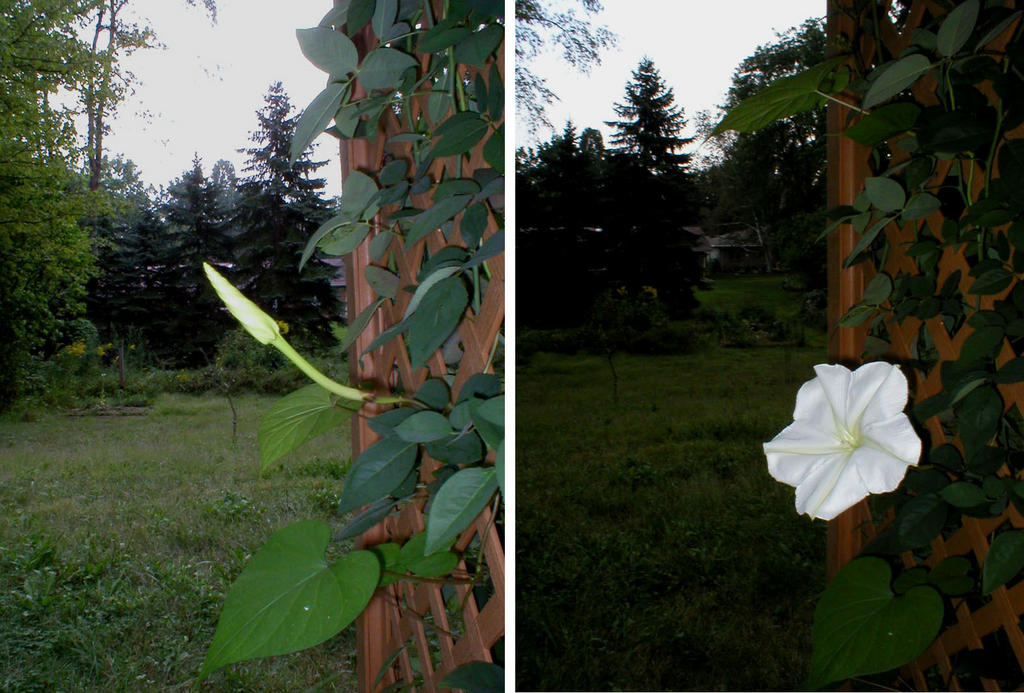
On my back patio I like to have plants for a night garden. The herb garden is there, and this year a heavily scented white Nicotiana. I have four o'clocks, scented geraniums, and sweet alyssum. Someday I would like to extend the little patio a bit. I have perused plans for pouring concrete, thought about gravel underlays and rebar reinforcement to survive our hard winters. But for now it is a small patio beside an herb garden held by a little retaining wall and an arched arbor.
On the arbor is a scented climbing rose Zepharine Drouhan, that has not yet bloomed. This is it's first year. A beloved David Austin rose Abraham Darby, failed to survive a hard winter a couple of years ago. So I have traded an extravagantly scented apricot rose for what I hope will be an equally extravagantly scented rose colored rose, that may be hardier. It has certainly climbed well in it's first year.
For years I have tried to grow moonflowers. They are huge morning glory like flowers that open at night and are supposed to be heavily fragrant. I never get them planted soon enough or transplanted soon enough. Last year I came close. Long spiraling buds appeared right before first frost. They never opened in the chilly nights.
Today as I headed out to the vegetable garden to do some weeding and trimming and tying, there was a big spiraling bud, larger and long necked unlike the Heavenly Blue morning glories I planted with the moonflowers last spring. The Heavenly Blues have done well, covering the top of my trellis with large blue flowers every morning. I took the bud's picture. A little over two hours later the sun had set and I came up in the twilight, and it was open! I took more pictures. The scent was not heavy, light and sweet, but it is a somewhat cool night. The flower is at least six inches across. I wish I had sat, with a glass of wine and perhaps someone to share the wine and evening flowers and watched it open. Tonight is a full moon as well, though obscured more than not by clouds.
It is supposed to be warmer over the next week, so I may have more. Summer refuses to relinquish its hold, but for these huge beauties I can tolerate some more heat.
Next year I will start them earlier in bigger pots, and give the a support to climb before they are set out. Perhaps in hot, breathless August my trellis will glow with enormous moonflowers glowing under a full moon.
Wednesday, September 14, 2005
Too Much Summer
Summer drags on and on. Some people are summer people loving heat and light. I am not.
My University is now on a Semester system, has been for some years now. So school starts a week or two before labor day.
Yes we settled the strike, the night before classes were to happen. Our take home will diminish over the next three years relative to inflation, unless the economy tanks, but what are we to do? The state is cutting us another 1.5 million dollars this year, and that is not even taking inflation into account.
A hundred years ago professors used to make four times the average income of someone in America working 12 months. At least one, G.H.M., complained that his salary was not sufficient to easily keep his and his wife’s nice clothes, good food, societal position, servants, laundry service and gardener. His budget was tight.
Ah, to have been that professor, freed of house and garden maintenance aside from what I wanted to do, being concerned about appearances in society. Well, maybe that would onerous. Appearances.
The U.S.A. used to have the best education in the world. These days we slip, and slip. No one much minds that we are 7th or13th. Our economy once flourished with innovation. Now we prefer to spend on advertising we want to convince the masses to buy based on name or sexiness, actual advances are secondary. We no longer truly care about academic excellence.
I am sluggish and slow and cranky with the long hot summer. Fall invigorates me. Crisp air, brilliant colors in my lovely park, the prospect of sharp night and a sharp mind await. Soon, soon.
For now it has been dry since the remains of destructive Katrina poured rain on us. I no longer can convince myself to water or mow. Tomatoes hang ripe, red peppers sit on bushes. Basil has gone wild and flowered. I need to tend to them. I just need cooler air and some time.
All our seasons are strangely shifted here. year after year I notice the same thing summer lingering into October. Then glorious color, a shot of adrenaline in sparkling clean air. Winter is delayed until January. Often enough deep freezes linger into April. Spring is cold, cold until May or June, then a short and vivid spring and back into the long energy and thought sapping summer.
I long for fall. I want to have energy. I want to WANT to be at my University. I want rain. I want to be able to think again.
My University is now on a Semester system, has been for some years now. So school starts a week or two before labor day.
Yes we settled the strike, the night before classes were to happen. Our take home will diminish over the next three years relative to inflation, unless the economy tanks, but what are we to do? The state is cutting us another 1.5 million dollars this year, and that is not even taking inflation into account.
A hundred years ago professors used to make four times the average income of someone in America working 12 months. At least one, G.H.M., complained that his salary was not sufficient to easily keep his and his wife’s nice clothes, good food, societal position, servants, laundry service and gardener. His budget was tight.
Ah, to have been that professor, freed of house and garden maintenance aside from what I wanted to do, being concerned about appearances in society. Well, maybe that would onerous. Appearances.
The U.S.A. used to have the best education in the world. These days we slip, and slip. No one much minds that we are 7th or13th. Our economy once flourished with innovation. Now we prefer to spend on advertising we want to convince the masses to buy based on name or sexiness, actual advances are secondary. We no longer truly care about academic excellence.
I am sluggish and slow and cranky with the long hot summer. Fall invigorates me. Crisp air, brilliant colors in my lovely park, the prospect of sharp night and a sharp mind await. Soon, soon.
For now it has been dry since the remains of destructive Katrina poured rain on us. I no longer can convince myself to water or mow. Tomatoes hang ripe, red peppers sit on bushes. Basil has gone wild and flowered. I need to tend to them. I just need cooler air and some time.
All our seasons are strangely shifted here. year after year I notice the same thing summer lingering into October. Then glorious color, a shot of adrenaline in sparkling clean air. Winter is delayed until January. Often enough deep freezes linger into April. Spring is cold, cold until May or June, then a short and vivid spring and back into the long energy and thought sapping summer.
I long for fall. I want to have energy. I want to WANT to be at my University. I want rain. I want to be able to think again.
Sunday, August 28, 2005
The Value of a Job
I am a professor. My faculty is unionized. We are on strike. We may settle tonight.
As a scientist, I could have made a salary two or three times more if I had gone into industry instead of academia. Instead, I chose to have intellectual freedom, control over what I do, the joy of basic research, and the personal rewards of opening young minds to the wonders of the natural world.
To get here I went to college at 17, worked as a technician for some years, went to graduate school for five years, earning two Masters and my PhD, and worked as a post-doc for four years. I had five first author papers in and four more that I was a middle author, all published in excellent peer reviewed journals. I applied for and was awarded grant money, I worked 60+ hours a week for years and years. I had student loans, which I have since paid off. I finally got my first real job at the age of 38. It was hard, wonderful, but hard.
Now I have tenure, and I am an Associate Professor. Somehow I am making over $15,000 less than average for a Professor of my rank at a public institution. My University’s contract offer, though better than the original one, will not keep up with inflation. So, in three more years, I can expect to be farther behind the average.
My country’s President doesn’t seem to care in any material way about higher education. My State governor has shifted money away from higher education to give tax breaks to businesses. My University, all my state’s universities, lost millions of dollars in funding over the last few years, in spite of increasing enrollment. My University is to get another 1.5 million dollar cut this year. Apparently universities are now less valuable than they used to be in our politicians eyes.
I was hired to teach two courses a term and run a research lab, training undergrads and grad students to do independent research. Now I teach three to four classes a term and still try to run a laboratory. I do not get paid to run my lab in the summer, but if I am not there my students flounder, needing advice and support. In lectures I teach over 500 students every year in non-majors biology, fundamentals of molecular and cellular biology, genetics, and virology. Fortunately I am single and can devote more of my life to my work than most of my colleagues can reasonably be expected to.
On the other hand, I get paid a reasonable middle class salary. I am not in dire need. In this inexpensive community paying my bills is easy on what I earn. I do not want a Hummer, my Honda is fine, I do not need a mansion, my house is in a lovely location, I do not need to go on cruises or buy designer clothes or go to Spas. I could use a maid and a guy to mow the lawn, but if my house gets particularly messy late in the term, or my shaggy lawn with dandelions irritate my neighbors it is not terribly important.
My problem is that I think that a Professor should be worth more. Are we not valuable? We have worked long and hard to get where we are. We try to better the lives of hundreds of people every year. Should we not be even more valuable as society becomes more and more advanced in technology, as health care becomes more complex?
Why do CEOs, and University Presidents, get big pay and benefit increases, why do businessmen, money managers, lawyers and marketers make so very much money. Why are their skills so much more valued than mine?
And, why is my value decreasing?
I do not yet know which way I will vote. I do not want to hurt my students. I do not want to feel trampled because of that.
As a scientist, I could have made a salary two or three times more if I had gone into industry instead of academia. Instead, I chose to have intellectual freedom, control over what I do, the joy of basic research, and the personal rewards of opening young minds to the wonders of the natural world.
To get here I went to college at 17, worked as a technician for some years, went to graduate school for five years, earning two Masters and my PhD, and worked as a post-doc for four years. I had five first author papers in and four more that I was a middle author, all published in excellent peer reviewed journals. I applied for and was awarded grant money, I worked 60+ hours a week for years and years. I had student loans, which I have since paid off. I finally got my first real job at the age of 38. It was hard, wonderful, but hard.
Now I have tenure, and I am an Associate Professor. Somehow I am making over $15,000 less than average for a Professor of my rank at a public institution. My University’s contract offer, though better than the original one, will not keep up with inflation. So, in three more years, I can expect to be farther behind the average.
My country’s President doesn’t seem to care in any material way about higher education. My State governor has shifted money away from higher education to give tax breaks to businesses. My University, all my state’s universities, lost millions of dollars in funding over the last few years, in spite of increasing enrollment. My University is to get another 1.5 million dollar cut this year. Apparently universities are now less valuable than they used to be in our politicians eyes.
I was hired to teach two courses a term and run a research lab, training undergrads and grad students to do independent research. Now I teach three to four classes a term and still try to run a laboratory. I do not get paid to run my lab in the summer, but if I am not there my students flounder, needing advice and support. In lectures I teach over 500 students every year in non-majors biology, fundamentals of molecular and cellular biology, genetics, and virology. Fortunately I am single and can devote more of my life to my work than most of my colleagues can reasonably be expected to.
On the other hand, I get paid a reasonable middle class salary. I am not in dire need. In this inexpensive community paying my bills is easy on what I earn. I do not want a Hummer, my Honda is fine, I do not need a mansion, my house is in a lovely location, I do not need to go on cruises or buy designer clothes or go to Spas. I could use a maid and a guy to mow the lawn, but if my house gets particularly messy late in the term, or my shaggy lawn with dandelions irritate my neighbors it is not terribly important.
My problem is that I think that a Professor should be worth more. Are we not valuable? We have worked long and hard to get where we are. We try to better the lives of hundreds of people every year. Should we not be even more valuable as society becomes more and more advanced in technology, as health care becomes more complex?
Why do CEOs, and University Presidents, get big pay and benefit increases, why do businessmen, money managers, lawyers and marketers make so very much money. Why are their skills so much more valued than mine?
And, why is my value decreasing?
I do not yet know which way I will vote. I do not want to hurt my students. I do not want to feel trampled because of that.
The Forest and the Trees
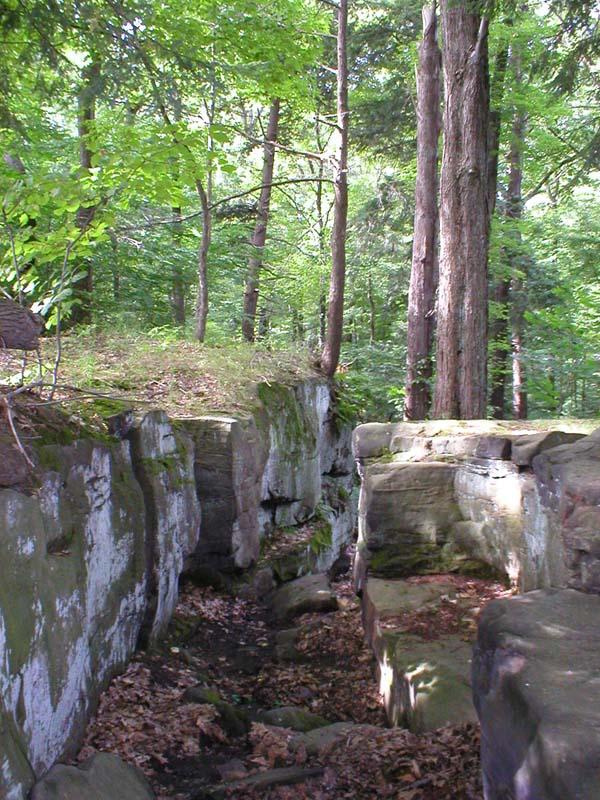
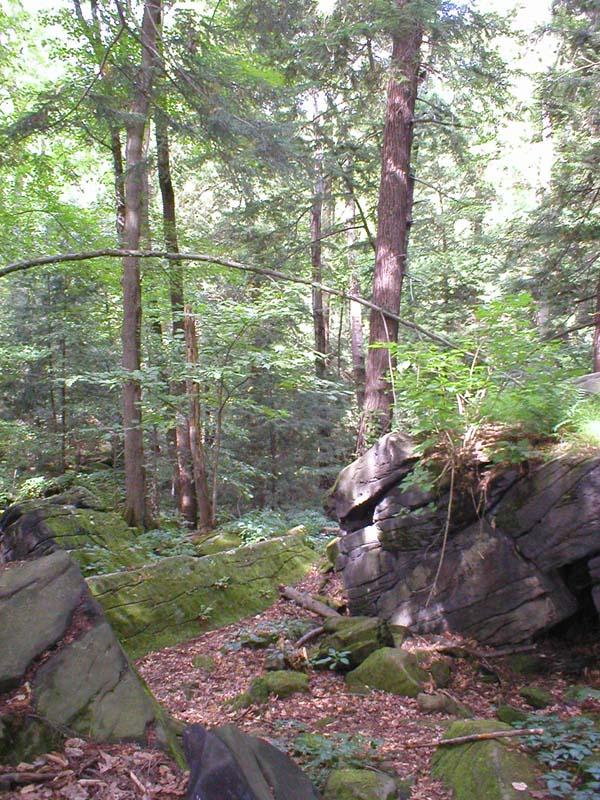
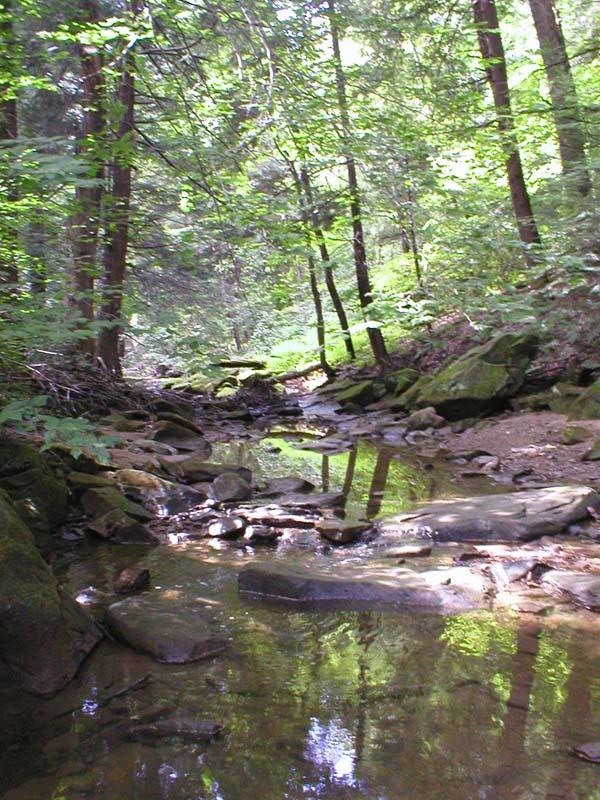
Across from my house is a forested park. It is a lovely watershed over 12 miles long, preserved. There are conifers that keep their somber green year round, hardwoods that will turn glorious shades of gold and red soon, ferns, wildflowers, rocks tumbling down to streams that feed into a large creek, a rocky gorge, a waterfall, an old mill restored and running.
I do not walk in it enough, though I drive through it almost every day to go to work. This summer I have had houseguests, so have been in it hiking up to the Mill, touring it, watching the great water wheel, and back more than once. It is a lovely 2 hour hike there, tour, and back on the opposite side.
Each tall tree has its roots in the soil. Tiny tubes made of cellulose run from root tip to the crowns of the tall trees. Cellulose is a polymer of sugar. The tiny sugar molecules linked together interact with water molecules in short lived electrical interactions lasting a millionth of a second. The water molecules bind to each other the same way. This causes the water to stick to itself, beading on leaves and spider webs, allowing water striders to skitter over the surface. It also causes the water to adhere to itself and the cellulose in an endlessly changing way. Water is used by the tissues of the tree, and evaporates from the leaves, constantly replaced through the tubes. These simple transitory, weak electrical forces are stronger than gravity, pulling water from roots to tree top with no pumping.
Each leaf has pigments that absorbed the energy from sunlight. Captured photons knock electrons from one place to another, powering the production of high energy molecules, splitting water to produce oxygen. The leaves have pores that release that oxygen. That is how our air has the oxygen that we need to breathe. Those pores also take in carbon dioxide, and with the high energy molecules form sugars. Those sugars make the cellulose, and also the sugars in sugar cane, and fruits, and grains, on which all animals, including us, depend.
The water of the creeks comes from rain, water precipitating out of moist warm air rising into colder air that cannot hold so much moisture. Running down into streams and creeks the force and chemical properties of the water cuts through layers of rock laid down in the distant geological past, scraped by glaciers, tilted by the motions of the great plates pushing against each other on the surface of the earth.
At the Mill the great water wheel turns in a dim cool interior. A small stream of water diverted from the top of the waterfall weights one side of the wheel, causing a steady motion in the massive wheel. Gears turn, transferring that power to a drive shaft that can be engaged to turn grind stones, power a sifter, clean energy from a waterfall.
I will not, now, discuss the biology behind the changing color of leaves in the fall, nor the little ecosystem of birds, mammals, insects and plants, or the gorgeous crystal symmetry of snowflakes in winter.
In the park, the angled layers of rock are cut and tumbled into a gorge, the water ripples and flows at the bottom, trees tower overhead, sunlight filters down from a blue sky with white puffy clouds, a great blue heron is poised by a pool, waiting in stillness.
All those amazing things together make such loveliness. It is so wonderful to stand in it surrounded by the beauty of the sight and sound and knowledge of it vibrating in one-ness.
A whole.
I do not walk in it enough, though I drive through it almost every day to go to work. This summer I have had houseguests, so have been in it hiking up to the Mill, touring it, watching the great water wheel, and back more than once. It is a lovely 2 hour hike there, tour, and back on the opposite side.
Each tall tree has its roots in the soil. Tiny tubes made of cellulose run from root tip to the crowns of the tall trees. Cellulose is a polymer of sugar. The tiny sugar molecules linked together interact with water molecules in short lived electrical interactions lasting a millionth of a second. The water molecules bind to each other the same way. This causes the water to stick to itself, beading on leaves and spider webs, allowing water striders to skitter over the surface. It also causes the water to adhere to itself and the cellulose in an endlessly changing way. Water is used by the tissues of the tree, and evaporates from the leaves, constantly replaced through the tubes. These simple transitory, weak electrical forces are stronger than gravity, pulling water from roots to tree top with no pumping.
Each leaf has pigments that absorbed the energy from sunlight. Captured photons knock electrons from one place to another, powering the production of high energy molecules, splitting water to produce oxygen. The leaves have pores that release that oxygen. That is how our air has the oxygen that we need to breathe. Those pores also take in carbon dioxide, and with the high energy molecules form sugars. Those sugars make the cellulose, and also the sugars in sugar cane, and fruits, and grains, on which all animals, including us, depend.
The water of the creeks comes from rain, water precipitating out of moist warm air rising into colder air that cannot hold so much moisture. Running down into streams and creeks the force and chemical properties of the water cuts through layers of rock laid down in the distant geological past, scraped by glaciers, tilted by the motions of the great plates pushing against each other on the surface of the earth.
At the Mill the great water wheel turns in a dim cool interior. A small stream of water diverted from the top of the waterfall weights one side of the wheel, causing a steady motion in the massive wheel. Gears turn, transferring that power to a drive shaft that can be engaged to turn grind stones, power a sifter, clean energy from a waterfall.
I will not, now, discuss the biology behind the changing color of leaves in the fall, nor the little ecosystem of birds, mammals, insects and plants, or the gorgeous crystal symmetry of snowflakes in winter.
In the park, the angled layers of rock are cut and tumbled into a gorge, the water ripples and flows at the bottom, trees tower overhead, sunlight filters down from a blue sky with white puffy clouds, a great blue heron is poised by a pool, waiting in stillness.
All those amazing things together make such loveliness. It is so wonderful to stand in it surrounded by the beauty of the sight and sound and knowledge of it vibrating in one-ness.
A whole.
Thursday, August 25, 2005
Almost Dreaming
I slide in and out of sleep easily. I have sat in seminars when very short of sleep, slipping in and out of dreams. I used to puzzle over the earlier scientific statements that dreams come in REM sleep, which takes hours to achieve. I wanted to call up sleep researchers and ask them how I slipped in and out of dreams so easily. If I am tired enough I do not even need to close my eyes.
My dreams are full color and all five senses are fully engaged. I have spent some time in some dreams trying to determine if I was dreaming. In one dream a cat’s tail had fallen off and was lying on the floor wiggling like a lizard’s tail. I was appalled. I worried about how to reattach it. I thought it must be a dream. This kind of thing doesn’t happen in real life. I sat on top of my made bed with my cat and her tail, trying to come up with a way to figure out if it was a dream, or whether I should call the veterinarian. Eventually I forced my eyes open in bed and sighed with relief that it was indeed a dream.
Sometimes my mind starts manufacturing the imagery before I am entirely asleep.
That was the case last night. It was very late. I was comfortably curled in bed. My mind generated a city as seen from a commuter train perhaps. Buildings passed in the light of early evening. I looked at them as they passed, still awake, marveling at my brain’s ingenuity. I tried to get the passage to slow, so I could see more detail, wondering how precise and complete my mind was making them. The image generating part of my brain would not comply. I caught the details of old brick here, a sinuous curve to the alignment of vertical windows from floor to floor there, the aged wood and paint of a tenement window frame farther on. Twenty story buildings rose from a background of three to five story buildings. The outlines were clear. I was looking at the backs not the fronts. The buildings were primarily brick, in various hues and ages. Some were wood and not holding up so well with age.
It was not yet a dream, there was no plot, no people, no odd dream changes. I simply watched in some amazement as the buildings passed by.
Eventually I slid fully into sleep. I do not know what I dreamed of.
My dreams are full color and all five senses are fully engaged. I have spent some time in some dreams trying to determine if I was dreaming. In one dream a cat’s tail had fallen off and was lying on the floor wiggling like a lizard’s tail. I was appalled. I worried about how to reattach it. I thought it must be a dream. This kind of thing doesn’t happen in real life. I sat on top of my made bed with my cat and her tail, trying to come up with a way to figure out if it was a dream, or whether I should call the veterinarian. Eventually I forced my eyes open in bed and sighed with relief that it was indeed a dream.
Sometimes my mind starts manufacturing the imagery before I am entirely asleep.
That was the case last night. It was very late. I was comfortably curled in bed. My mind generated a city as seen from a commuter train perhaps. Buildings passed in the light of early evening. I looked at them as they passed, still awake, marveling at my brain’s ingenuity. I tried to get the passage to slow, so I could see more detail, wondering how precise and complete my mind was making them. The image generating part of my brain would not comply. I caught the details of old brick here, a sinuous curve to the alignment of vertical windows from floor to floor there, the aged wood and paint of a tenement window frame farther on. Twenty story buildings rose from a background of three to five story buildings. The outlines were clear. I was looking at the backs not the fronts. The buildings were primarily brick, in various hues and ages. Some were wood and not holding up so well with age.
It was not yet a dream, there was no plot, no people, no odd dream changes. I simply watched in some amazement as the buildings passed by.
Eventually I slid fully into sleep. I do not know what I dreamed of.
Sunday, August 07, 2005
An Experiment
I am a scientist. I run a small research lab that works on some specific DNA in yeast. I have undergraduates and Masters students doing research in my lab. I also teach at my University, typically three classes a term. My research students also take classes, so none of us have the kind of dedicated time to do science that I was used to as a graduate student and a post-doc. I do not have the time to monitor my researchers as closely as might be ideal, and only going to Masters, as soon as a student is trained they are moving on.
I was on a half sabbatical in England two years ago. To both my pleasure and dismay, I accomplished more in 5 months by myself there than all my students combined over 9 years here. Part of that is due to facilities, part due to training, and part to having or not having intellectual colleagues to help with ideas and trouble-shooting.
Nonetheless, this afternoon I am happy.
I have a grad student who has taken rather longer than usual to complete her Master's research. Part of that is due to have two babies while in grad school. Having babies and being a parent tending them will slow down other aspects of life, as it should. Fortunately there is little time pressure on how long you take. But part was a series of technical problems. My student was a good student, but I did not always have the time to supervise her as closely as might be ideal. Sometimes she didn’t do every control she needed, other times she might slip up on a technique I could have caught if I had been paying closer attention.
Finally she had made it through all her earlier technical problems and had successfully made all the genetic changes necessary for her actual experiment. This was not trivial, creating the right cells to compare with normal ones. She did the experiment (involving mating and inheritance patterns) on the cells without the genetic changes. Then did the experiment with the altered cells and suddenly the experiment failed. There were no mated cells. She had not used the original strains for her controls as she should have. Nonetheless, something was very wrong. She repeated it a couple of times, still without t the controls unfortunately, and the experiment simply did not work. My fear was that there was something wrong with the strains she had laboriously created over the past couple of years. Meanwhile, my student's husband needed to move on to his fellowship, and she HAD done a lot of work. So I told her to go and write her thesis. Even though we did not have the answer, she had done enough work for a Masters.
Over the Spring and first part of summer I had undergrads in my lab learning about research. I taught them how to grow the cells, isolate DNA and had them check the altered strains step by step. Everything we checked was working, yet the experiment still failed. It was as if something was killing the cells.
At the end of the term I looked hard at the sterilized filters in the container we put them in to be sterilized we were using.
They looked wrong.
No one knew exactly what they were and where they came from.
I became suspicious that they were a filter type that binds permanently to proteins. Cells would never be released to grow. I was particularly suspicious when I could not find the right filters in their original boxes anywhere in the lab, though there was several containers of the wrong ones (unsterilized).
So I ordered the right filters. I started growing the cells, made sure they were up to growing fast and healthy. Then put in a 14 hour day last Wednesday repeating the experiment, with lots of controls.
It Worked! There are plenty of mated cells that grew into colonies. Now over the next few days, I will grow the colonies up, then isolate their DNA, then cut it, separate it by size on a gel, make some radioactive probes, and see if their inheritance pattern has changed. Finally I can analyze them and find out the answer to the original question.
The grad student says that yes, at the beginning she used filters I had prepared, then she ran out and sterilized the next batch herself. She asked me about the filters, I told her where to find them, and did not think to double check to make sure we hadn’t accumulated the wrong variety. If only I had noticed the filters looking wrong a year ago.
I was on a half sabbatical in England two years ago. To both my pleasure and dismay, I accomplished more in 5 months by myself there than all my students combined over 9 years here. Part of that is due to facilities, part due to training, and part to having or not having intellectual colleagues to help with ideas and trouble-shooting.
Nonetheless, this afternoon I am happy.
I have a grad student who has taken rather longer than usual to complete her Master's research. Part of that is due to have two babies while in grad school. Having babies and being a parent tending them will slow down other aspects of life, as it should. Fortunately there is little time pressure on how long you take. But part was a series of technical problems. My student was a good student, but I did not always have the time to supervise her as closely as might be ideal. Sometimes she didn’t do every control she needed, other times she might slip up on a technique I could have caught if I had been paying closer attention.
Finally she had made it through all her earlier technical problems and had successfully made all the genetic changes necessary for her actual experiment. This was not trivial, creating the right cells to compare with normal ones. She did the experiment (involving mating and inheritance patterns) on the cells without the genetic changes. Then did the experiment with the altered cells and suddenly the experiment failed. There were no mated cells. She had not used the original strains for her controls as she should have. Nonetheless, something was very wrong. She repeated it a couple of times, still without t the controls unfortunately, and the experiment simply did not work. My fear was that there was something wrong with the strains she had laboriously created over the past couple of years. Meanwhile, my student's husband needed to move on to his fellowship, and she HAD done a lot of work. So I told her to go and write her thesis. Even though we did not have the answer, she had done enough work for a Masters.
Over the Spring and first part of summer I had undergrads in my lab learning about research. I taught them how to grow the cells, isolate DNA and had them check the altered strains step by step. Everything we checked was working, yet the experiment still failed. It was as if something was killing the cells.
At the end of the term I looked hard at the sterilized filters in the container we put them in to be sterilized we were using.
They looked wrong.
No one knew exactly what they were and where they came from.
I became suspicious that they were a filter type that binds permanently to proteins. Cells would never be released to grow. I was particularly suspicious when I could not find the right filters in their original boxes anywhere in the lab, though there was several containers of the wrong ones (unsterilized).
So I ordered the right filters. I started growing the cells, made sure they were up to growing fast and healthy. Then put in a 14 hour day last Wednesday repeating the experiment, with lots of controls.
It Worked! There are plenty of mated cells that grew into colonies. Now over the next few days, I will grow the colonies up, then isolate their DNA, then cut it, separate it by size on a gel, make some radioactive probes, and see if their inheritance pattern has changed. Finally I can analyze them and find out the answer to the original question.
The grad student says that yes, at the beginning she used filters I had prepared, then she ran out and sterilized the next batch herself. She asked me about the filters, I told her where to find them, and did not think to double check to make sure we hadn’t accumulated the wrong variety. If only I had noticed the filters looking wrong a year ago.
Wednesday, July 27, 2005
Summer Cold Front
The sky darkened early.
It has been hot. I am not someone who likes heat. Truly I do not understand how so many love heat. I do not like sweat dripping, nor being restricted to air conditioned enclosures to avoid it.
The days have sizzled. The temperature hovered in the low 90s Fahrenheit (33 Celsius) all afternoon and into the evening. The humidity washed the blue out of the sky and made the air thick and wavy. Every day there was a forecast for possible thunderstorms. Every evening they arrived north of here or south of here, skirting to the east, or emerging and dissolving nearby in the west. Right here, nothing but humidity.
Last night the thunderstorms were inevitable. A cold front was coming. The weather maps showed masses of green, yellow, and boiling red storms coming closer and closer. The first waves skipped around here, as usual, but filled the air with growling thunder.
Finally we were overrun.
I stood in my breezeway watching the lightening bolts fly one after another, pink in the distance, gold closer, blue-white here. The thunder never stopped, deep rumbles, bone rattling booms, cracks that felt as if they would separate my mind from my body. The rain drove down in sheets, the sky flashed with blinding lightening, the thunder drummed unrelentingly.
Eventually the explosive storms drove all other thoughts out of my head. The storm consumed me and left me gasping.
Today, the air and garden are being washed clean by gentle rains and blessed coolness.
It has been hot. I am not someone who likes heat. Truly I do not understand how so many love heat. I do not like sweat dripping, nor being restricted to air conditioned enclosures to avoid it.
The days have sizzled. The temperature hovered in the low 90s Fahrenheit (33 Celsius) all afternoon and into the evening. The humidity washed the blue out of the sky and made the air thick and wavy. Every day there was a forecast for possible thunderstorms. Every evening they arrived north of here or south of here, skirting to the east, or emerging and dissolving nearby in the west. Right here, nothing but humidity.
Last night the thunderstorms were inevitable. A cold front was coming. The weather maps showed masses of green, yellow, and boiling red storms coming closer and closer. The first waves skipped around here, as usual, but filled the air with growling thunder.
Finally we were overrun.
I stood in my breezeway watching the lightening bolts fly one after another, pink in the distance, gold closer, blue-white here. The thunder never stopped, deep rumbles, bone rattling booms, cracks that felt as if they would separate my mind from my body. The rain drove down in sheets, the sky flashed with blinding lightening, the thunder drummed unrelentingly.
Eventually the explosive storms drove all other thoughts out of my head. The storm consumed me and left me gasping.
Today, the air and garden are being washed clean by gentle rains and blessed coolness.
Subscribe to:
Posts (Atom)


